How I Beat My Phone Addiction With Grayscale
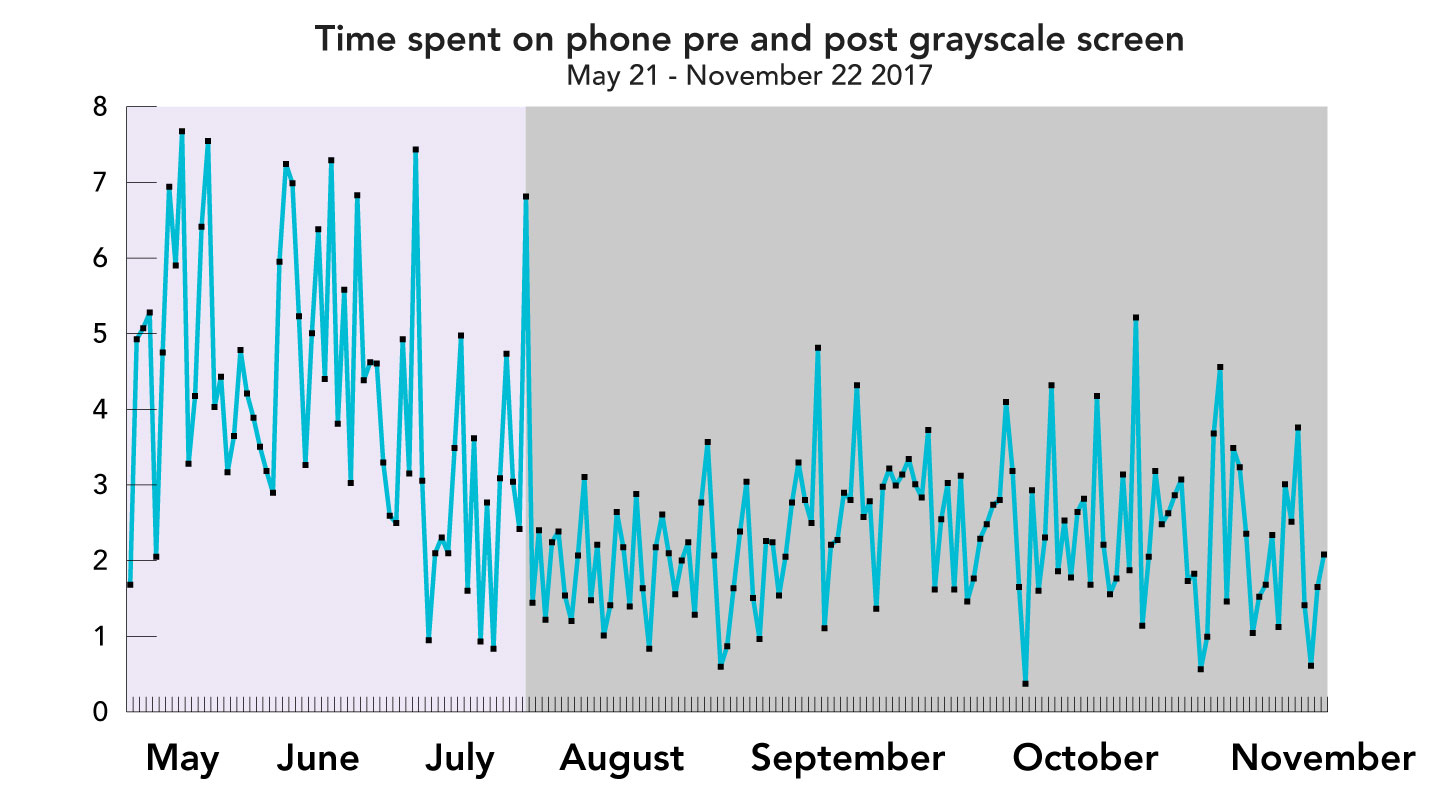
Going gray: The Numbers
Earlier this year, I started to become more conscious of how much time I was spending on my phone. More importantly, conscious of what I was doing on my phone. I started reading more Cal Newport and Tristan Harris. Constant distractions eroding our ability to focus? Social media is like slot machine gambling? Companies are optimizing apps to get us addicted? These were heavy implications, but I've always had a feeling we're not entirely sure of what smartphones are doing to us. Have you ever noticed your hand reaching for your phone when you're reading a book or talking to a friend? Were you even aware of that? That has to mean something and science is usually slow to catch up.
The scientist in me was itching. I sensed an experiment. How did I use my phone? How much time did I spend on it? What apps occupied most of my time? The only way to find out was to measure it.
Baseline: 4 hours 50 minutes/day
May 21 - June 10, 2017
Before grayscale: 4 hours 8 minutes/day
June 11 - July 21, 2017
After grayscale: 2 hours 14 minutes/day
July 22 - November 22, 2017
With app usage tracking enabled, first I needed to set my baseline. I used my phone normally for 21 days. In those weeks, my average phone use was 4 hours and 50 minutes. That's almost half a work day, and only 2 hours less than the sleep you're supposed to get. What was I doing on my phone?
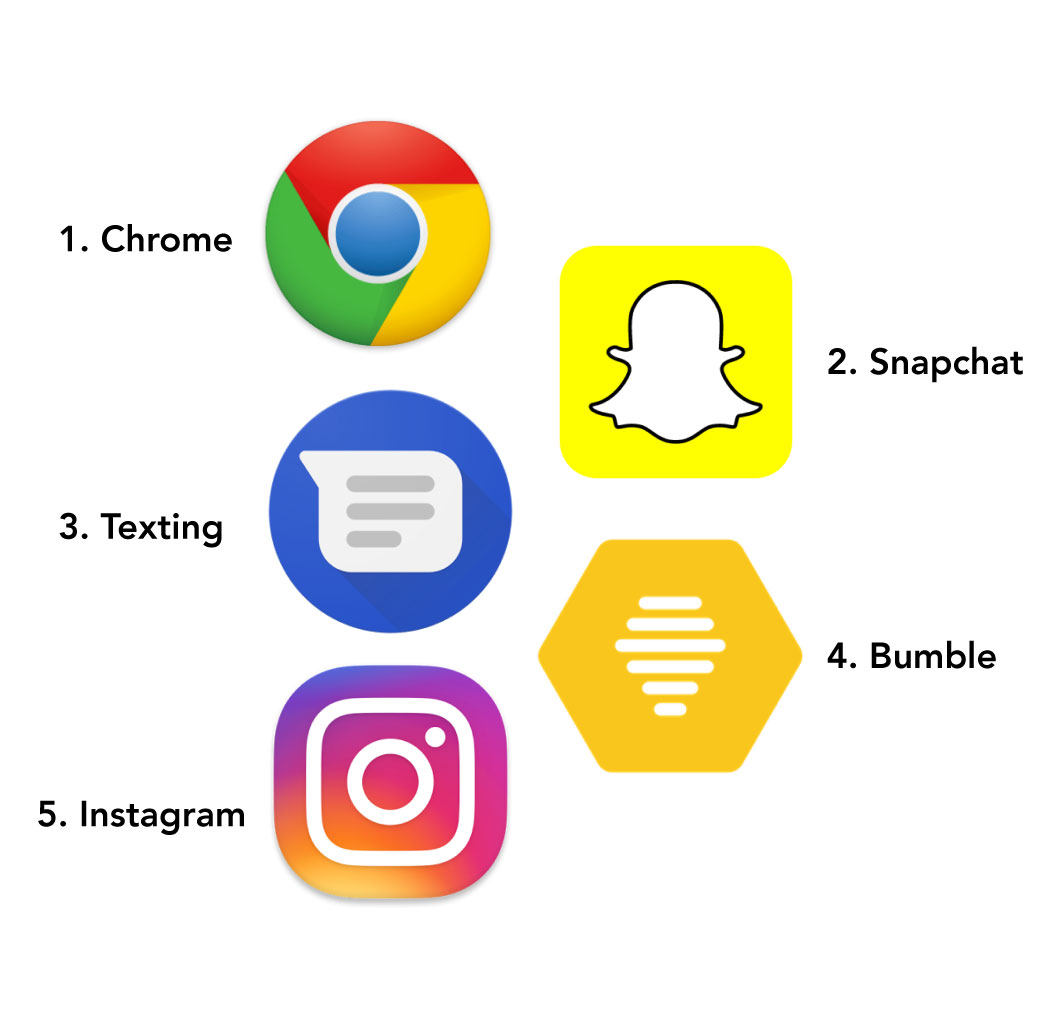
Aside from Chrome, I was doing a whole lot of nothing for close to 5 hours a day on my phone. After this realization began the attempts to reduce my phone usage. The following 6 weeks is best compared to a rollercoaster. A tactic I used was leaving my phone in my room all day. Unfortunately, I would binge use my phone in the days right after.
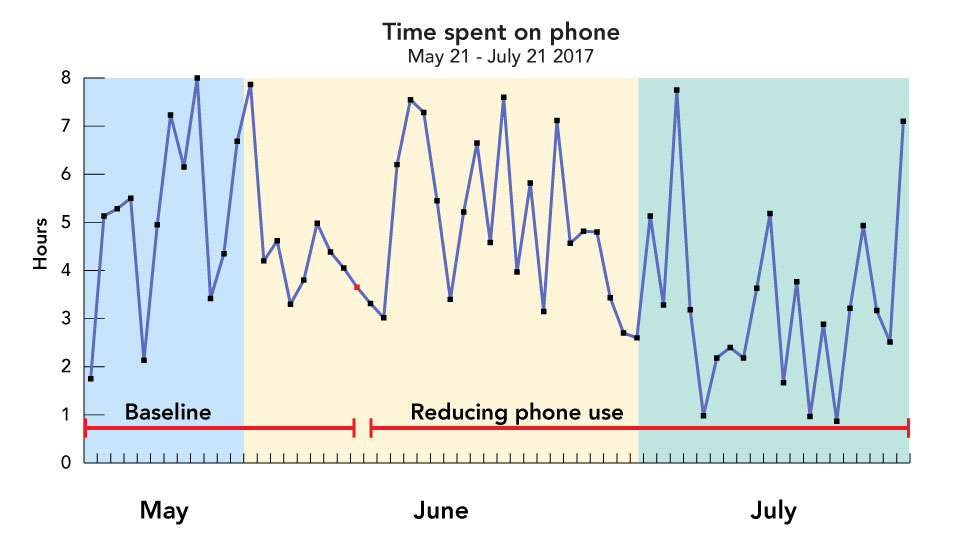
My average phone use in this 6 week period was 4 hours and 8 minutes. Remember, this was me consciously trying to reduce my phone use and I barely shaved off 40 minutes. Thankfully, on July 22nd, I found grayscale mode. One article mentioned that some phones have grayscale mode, which may help reduce phone addiction. At that point, I was willing to try anything.
I don't know how else to say it, other than the difference was night and day. My phone was hideous and boring to look at. But adjectives aside, what did the numbers say?
My phone use on July 21, pre-grayscale: 4 hours and 4 minutes. Day one of grayscale? 1 hour 30 minutes. Interesting. A week? 1 hour and 54 minutes. The full month with grayscale, my average was 2 hours and 4 minutes.
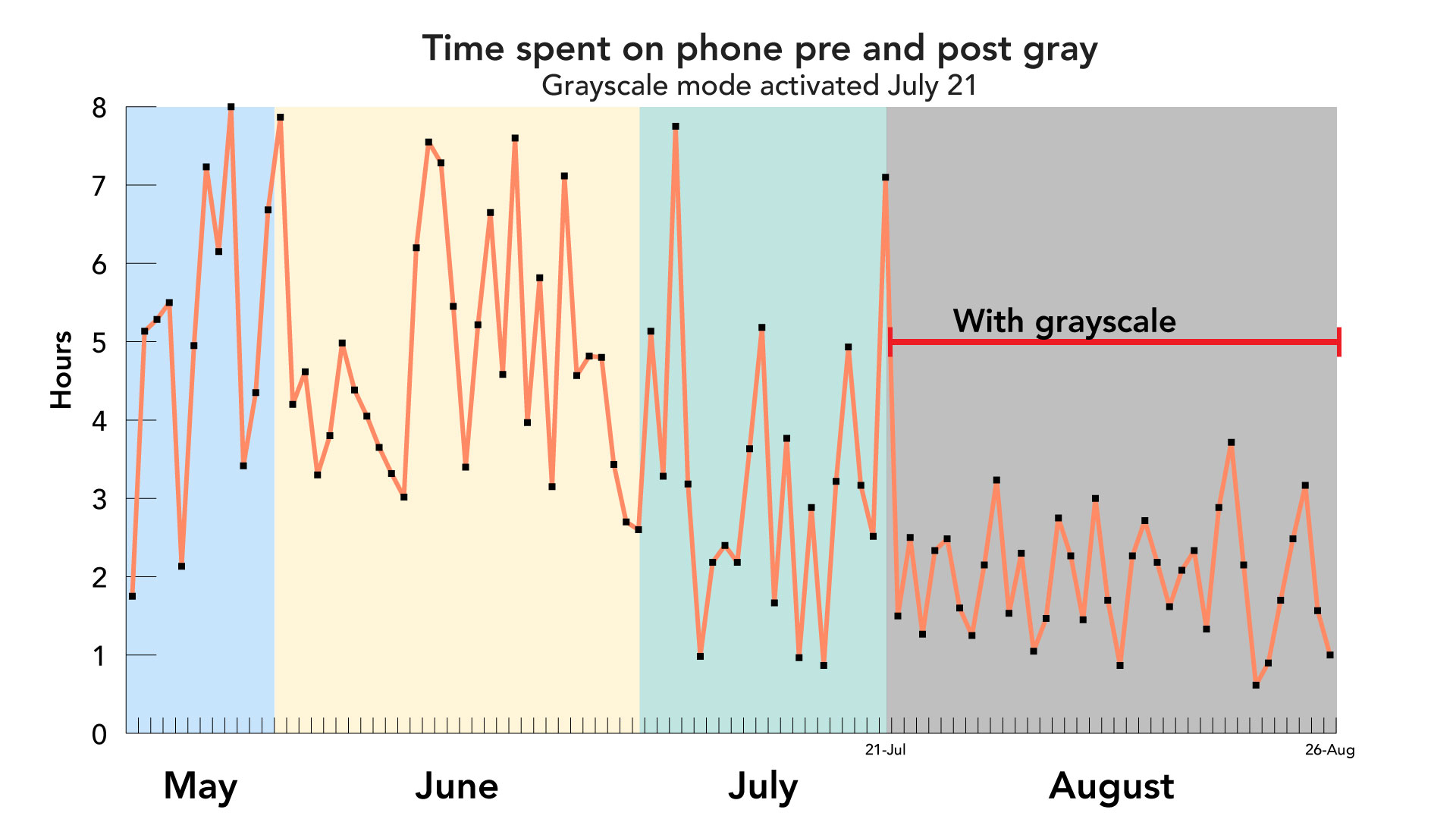
That's HUGE. Phone use pre-grayscale was 4 hours and 8 minutes. After a month of grayscale, it was 2 hours and 4 minutes. Was it really as simple as turning my phone screen gray?
I think a couple things happened. Did my hand still unconsciously drift towards my phone? Initially, yes. Grayscale didn't magically turn off that reflex. But what happened after I unlocked my phone was different. Everything on my screen was gray and muted: my brain had associated certain colours with certain apps (yellow: Snapchat, pink-orange: Instagram, orange: Reddit). Without colour, I had to actively search for apps on my screen, which gave me enough time to realize what I was doing.
The second barrier: if I did find myself on social media, nothing stood out. Videos and photos without colour were terribly boring. The last barrier was a mental trigger: a gray screen reminded me to put my phone down and look up at the world.
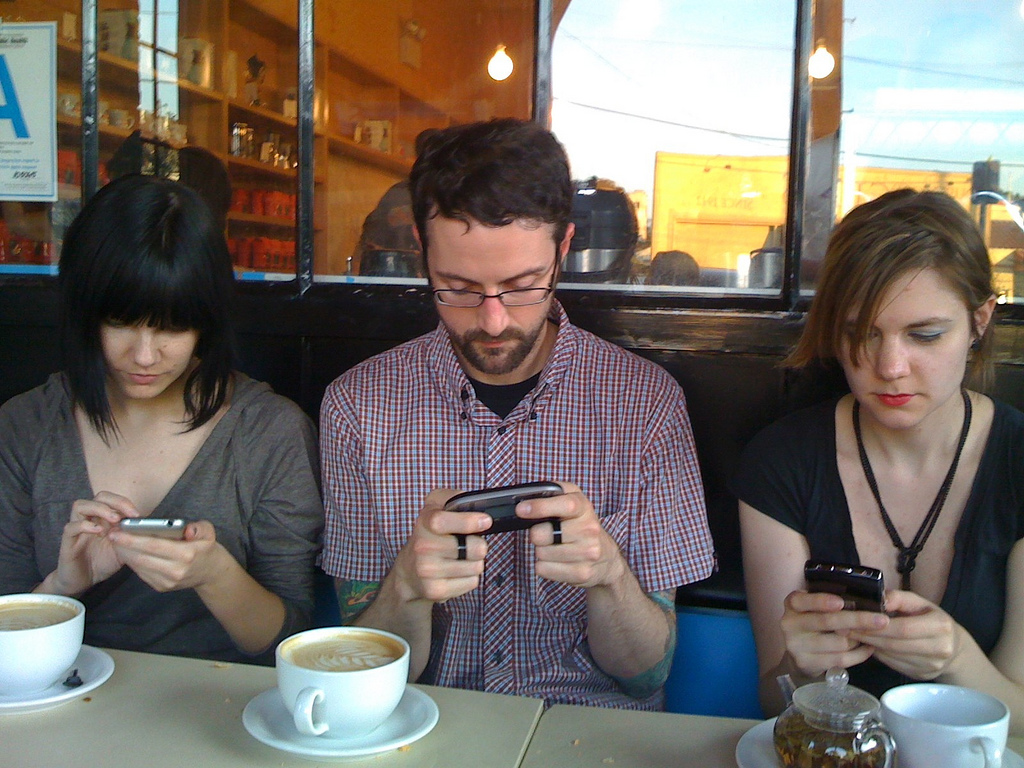
I've never been a fan of "dumb phones" as a solution. Smartphones are meant to be a tool to make our lives better. Pretending it's 2004 is not a solution. Dumb phones do more harm than good and chances are you'll binge use your phone as soon as you get it back. This is no different than a person trying to lose weight by dieting. Diets don't work because the secret is to establish habits that are sustainable long-term. I think grayscale can be that sustainable habit.
Where I think going gray excels is in killing the craving. Going gray turns the sugary allure of smartphones into something bland: it looks and tastes horrible, but it gets the job done. And who's to say we can't have some dessert every now and then? I turn off grayscale for a few minutes when I want to watch an entertaining YouTube video. This is a habit that is sustainable for me. I don't feel that I've lost something in my life by going gray. I've gained a couple hours in fact.
I give my friends full attention when they speak to me now that my phone isn't a quick glance away. I'm more present with the people I care about. I've started to see the colour in the world again, instead of in my phone.
Latest stats (up to November 22, 2017)
Learn how to turn your phone screen grayscale: Go Gray
References
1) Montag, C., et al. (2015). The importance of analogue zeitgebers to reduce digital addictive tendencies in the 21st century. Addictive Behaviors Reports, 2, 23-27.
2) Choi, H.-S., Lee, H.-K., & Ha, J.-C. (2012). The influence of smartphone addiction on mental health, campus life and personal relations.
3) Kwon, M., et al. (2013). Development and Validation of a Smartphone Addiction Scale (SAS). PLoS ONE, 8(2).
4) King, R. C. (2017). The impact of smartphone on young adults. 8(4), 342-350.
5) Andrews S., Ellis, D.A, Shaw, H., Piwek, L (2015). Beyond Self-Report: Tools to Compare Estimated and Real-World Smartphone Use.
Get notified when the Go Gray App launches
Shortcuts and automations for Grayscale, plus usage stats.